

This post was originally published on this site.
Mulberry reported 18% sales growth in its latest trading update for the first half of 2026, which it credited to strong customer demand for both its seasonal and core collections and greater visibility following its return to London Fashion Week with Christopher Kane.
Summary of results
-
Group sales rose 18.1% at actual currency and 18.2% at constant currency, in line with the board’s expectations.
-
US sales rose 28% (like-for-like +34%), higher than the UK, which saw a sales boost of 10% (like-for-like +9%).
-
Franchise and wholesale sales climbed 52%.
Mulberry’s trading update follows positive momentum for the brand as it continues to execute its “Back to the Mulberry Spirit” strategy under CEO Andrea Baldo, which focuses on restoring profitability through stronger full-price trading, reduced promotional activity and renewed investment in the brand.
In July this year, the company reported that it had cut underlying losses to £8 million from £24.1 million and had returned to a positive underlying EBITDA of £0.8 million, an improvement of £17.6 million year on year.
In its latest trading update, Mulberry CEO Andrea Baldo commented that he was “pleased with the progress made during H1” and that the growth in full-price sales was “particularly encouraging.”
“The launch of Mulberry by Christopher Kane and our return to London Fashion Week marked a significant moment for the brand, celebrating our British heritage and generating strong customer engagement, greater brand visibility and increased traffic across stores, digital platforms and third-party partners.
“There remains much more to achieve as part of our strategic plan, and we are operating in a challenging trading environment. However, we enter the second half with a strong product pipeline, increased brand desirability and a clear focus on delivering our strategy,” he added.
The British luxury brand reported growth across every region and channel, with franchise and wholesale seeing a particularly strong boost in sales, up 52%. Wholesale accounted for 17% of total sales in the half year, up from 16% in the same period last year.
Across markets, the US reported the strongest growth, with sales up 28% at actual currency, followed by Europe (ex UK), where sales grew by 23%, and the UK, which saw sales rise by 10%. Mulberry credited its strong US performance to stronger customer demand, positive digital performance and a wider wholesale presence.
In its AGM presentation in September, the group highlighted the US, as well as the UK and the Asia-Pacific market, as key priorities. Plans to invest in its home market include opening a 979 sq ft store at Liverpool ONE in November.
Mulberry also noted that it had resisted discounting during the first half of trading and had seen a 300-basis-point fall in the promotional share of sales, which supported gross margins.
Styles that performed particularly well for Mulberry included new introductions such as its Raffia, Crochet and Stevie styles, as well as the Darley Camera Bags. Demand also continued for the Bayswater and Lily styles. For the second half, the brand noted the launch of new styles, including the recently launched Delilah bag.
The group noted that it was maintaining its annual revenue target of £200 million and a 15% adjusted EBIT margin over the medium term. In July, the group reported a 4% increase in group revenue to £125.5 million.
Runway debut landed in the final week
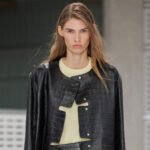
Mulberry by Christopher Kane, the brand’s first runway show in six years, took place at London Fashion Week in September. The SS27 ready-to-wear and accessories collection transformed the Bayswater handbag into leather garments, reworked founder Roger Saul’s Somerset roots into axe motifs and drew its colour palette from the house archive.
Kane was appointed Creative Director of Women’s Ready-to-Wear in March. In his first-ever show for the house, he brought his distinct creative vision to the brand through design, craftsmanship and culture, while opening a new chapter for Mulberry beyond its accessories core. As part of pandemic-era cost-cutting in 2020, Mulberry ended its clothing and footwear licence with Onward Luxury Group. Its final ready-to-wear range, designed by Johnny Coca, was for AW20.
Chief Executive Andrea Baldo said the show generated “strong customer engagement, greater brand visibility and increased traffic across stores, digital platforms and third-party partners.”