

This post was originally published on this site.
At the tail end of London’s Bakerloo tube line, heading towards a north-west London suburb called Harlesden, the whirring sound of manufacturing, from rotating electronic motors to cooling fans, can be heard.
Here, trading parks, depots and industrial estates are located, necklacing the busy North Circular road, where clotted traffic inches along.
Tech startup Isembard (named after the famous civil engineer Isambard Kingdom Brunel) has one of its factories, its first, which opened in January 2025, located here.
Isembard’s 33-year-old sole founder is Alex Fitzgerald, a former Army reservist, described by one investor as a person who “lights you up”, who already has one startup exit behind him having sold to an investment giant.
Factory tour
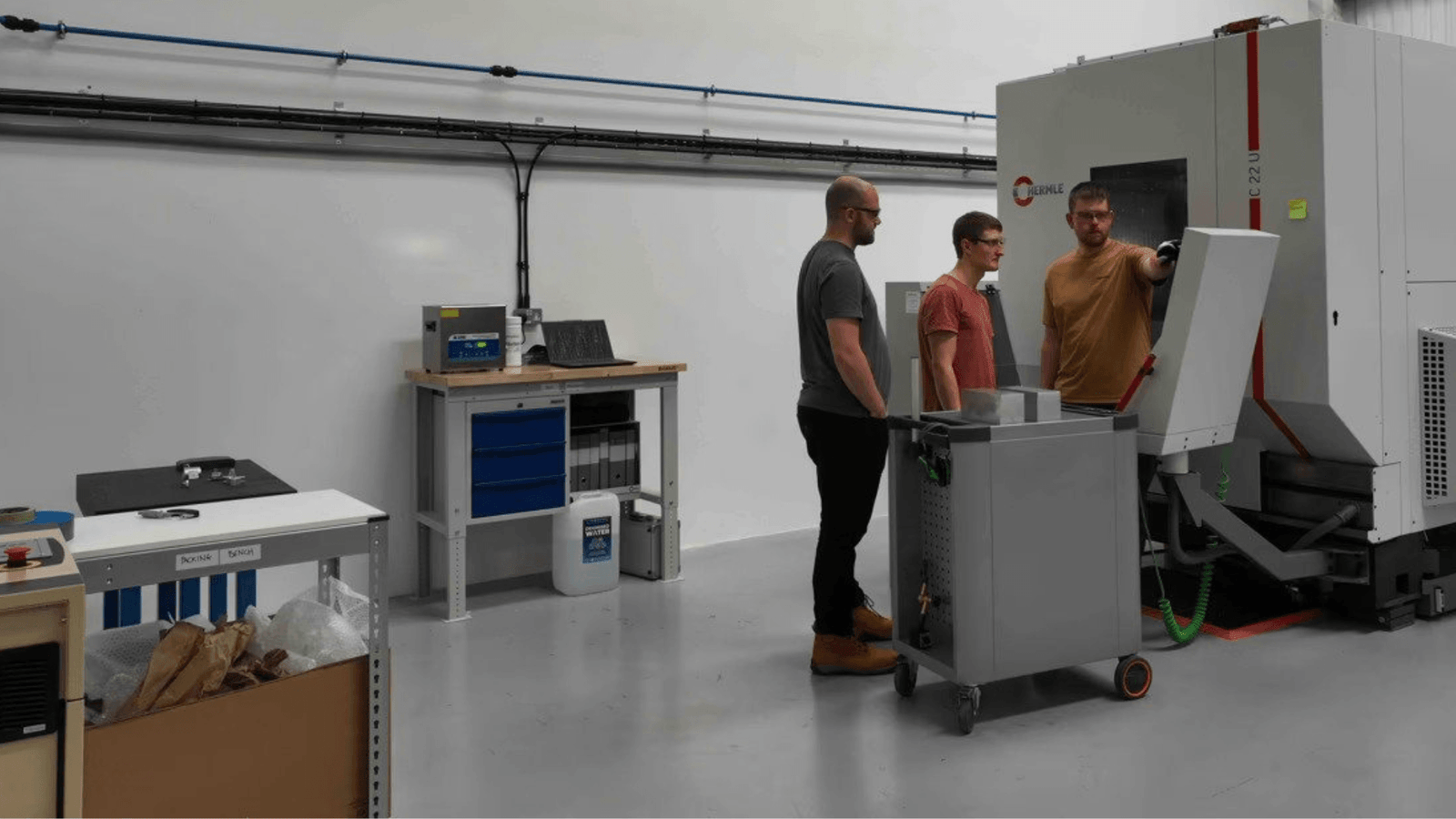
Fitzgerald greets Tech.eu on arrival and then gives us a quick tour of the factory floor, where high-spec machines, using techniques like injection moulding and axis milling, hum and clang.
Repairing to an upstairs office, Fitzgerald, who is casually dressed, says Isembard could serve as a blueprint for the ambitions of the UK’s new prime minister, Andy Burnham.
Or as Fitzgerald puts it, in high-definition: “If you think about this business, it’s a politician’s wet dream.”
Factories, entrepreneurship, regional jobs, supporting crucial industries, reindustrialisation, reshoring- Isembard ticks all these boxes, he points out. Fitzgerald has recently been to Number 10, and the message appears to have reached team Burnham, who “might be coming to the factory”. Eighteen months since launch, Isembard is now on a PR offensive, as it looks to rapidly scale its business.
Fitzgerald, CEO, says: “I think the biggest thing is getting people to know about us.
“If you think about the total of population of the UK, how many people know you can start your own factory with support and make rocket parts?”
What does Isembard do?
Isembard is a kind of modern-cum-old fashioned business, marrying the worlds of reindustrialisation and reshoring with software and AI. It develops small high-tech factories which are run on a hybrid model of company-owned and franchised.
These factories can quickly and cheaply manufacture precision component parts for a range of critical industries including space, defence and robotics, with its customers including Anduril, Tekever, ARX Robotics and the UK government.
For example, a defence company wanting to make a part for an autonomous submarine will send Isembard a design for key parts in a computer file, Isembard will quote a price, then make the part (and potentially assemble) and ship it quickly.
The fulcrum of Isembard is a piece of tech called MasonOS, an AI-powered bit of software which brings the whole kit and caboodle- from orders, design, tracking goods and scheduling- under one roof, giving full visibility of the supply chain.
Industry ripe for disruption
Isembard is disrupting a $1 trillion-a-year component manufacturing industry, which is on the wane as the small, independent family-run incumbents are dying out at a time of rising demand from companies and governments for component parts.
Furthermore, UK-headquartered startups like Isembard are à la mode, as they tap into Burnham’s reshoring agenda, returning manufacturing to the UK, which had been outsourced or moved overseas for cost-cutting reasons.
Another big tick for Isembard, says Fitzgerald, holding a chunk of metal, is the satisfaction of tangible work, amid an increasing crisis in the meaning of work.
Fitzgerald says: “I can go into work in the morning, and there is a block of metal like this worth £100. At the end of the day, it’s worth £1,000, and it’s going onto a rocket that is going into space.”
Factories on the increase
Isembard, which employs 66 people,now operates 14 factories, seven in the UK, five in the US, one in France and one in Germany, with plans to hit 25 by year-end. Next up is Ukraine, where Isembard is hunting for a general manager, and hopes to help with the country’s reconstruction, following the Russia war.
Fitzgerald admits the perception of franchise businesses is “unsexy”, synonymous with “slow-moving businesses”, a perception he wants to overturn.
Setting up a franchise factory can be done in three months, he says, requiring a couple of CNC machines (a kind of lathe for making metal parts), power, some coolant, four walls, and a few other bits provided by Isembard.
First franchisee
Isembard’s first franchisee is Shawn Rowcliffe, a 22-year-old former machine operator with defence giant Babcock, who decided to branch out alone.
Rowcliffe told the BBC: “I think it was just an opportunity to put my own stamp on things and have a bit of pride in what I do – it’s very exciting that I’ve managed to do this on my own.
“I’m a machinist by trade, not a businessman, so I’m learning as I go, but with the right support it’s all possible.”
Isembard franchisees are a potpourri of personnel, including a restaurant franchisee, a cardiac nurse, an engineer, a military veteran, and an investor.
Their one commonality is “having the ambition to build something on their own but with support”, Fitzgerald says.
Challenges
Like other startups, a key challenge facing Isembard is scaling geographically rapidly, while maintaining a high-quality of product, experts say. Another challenge will be beefing up MasonOS amid rapid AI advancements.
Stephen Millard, partner, Notion Capital, which led Isembard’s seed round, says: “I was sceptical. When you think about a franchise within a startup, you question the validity, but then you say ‘it’s no different from a typical commercial route to market’.”
Investors
In March this year, Isembard raised a $50m Series A funding round, less than 12 months after its $9m seed round.
The round was led by US investor Union Square Ventures, an early backer of Twitter and Coinbase.
New US deeptech investors Tamarack Global and IQ Capital participated along with existing investors Notion Capital and CIV. Angel investors include Alex Bouaziz, founder and CEO of Deel, and Matt Briers, the former Wise CFO.
Was it important to have a US investor lead the round?
“Not especially,” Fitzgerald says.
He adds: “We get on really well with the Union Square Ventures team. They were one of the first investors in Twitter and Coinbase and Twilio. And their whole thesis is investing in network effect businesses, like our franchise business.”
Long hours
Fitzgerald, who is married to a lawyer, cranks out the hours, working from 8am up until 10pm, even 11pm, during the week, sometimes six days a week.
Ninety per cent of his life is work, he says, with the rest family time and exercise.
Tough on your partner? “It is hard,” he admits.
He says he’s “probably working ten times harder” on Isembard than his last startup, broadband disruptor Cuckoo. Comparing his two startups, Fitzgerald does not shy from ambition and can sound grandiose.
He says: “If the world achieved what it wanted to do with broadband, people would be slightly less annoyed with their broadband provider. If we achieve what we want to achieve with Isembard, the West’s prosperity, security and purpose is solved.”
Fitness man
An exercise junkie, the former Army reservist looks more like a bodybuilder than a startup builder. Runs and CrossFit every other day are complemented by 30-minute one-to-one power walks with the team around the industrial estate.
Currently reading the Odyssey, he describes his interests as “peripatetic”, ranging from tax, geopolitics, science, engineering and economics.
Management style
He says his management style is “hands on” in some areas, “hands off” in other areas.
Likening himself to a pig hunting for truffles, he says: “My most important thing is finding and nurturing great engineers and operators. I think finding when you are scaling is one of the most important things.”
He also takes inspiration from elsewhere, he says, citing a military command called “mission command” (centralised intent, but decentralised decision-making) and a famous Rabbi Hillel quote on taking personal responsibility and acting without delay.
Significant amounts of working time are blocked out to do “deep dives” across the business, but he’s not an ivory tower-type leader, preferring to muck in with customer calls and packaging parts for customers.
Background
Fitzgerald grew up in London (his mum is an NHS doctor) and dad (retired lawyer). He went to the prestigious, fee-paying Westminster School (“I was a bit in my shell”), then studied biochemistry at Nottingham University.
After a spell as an intern journalist at CityAM, he spent three years in the Treasury (working on tax policy and as an economy spokesman).
He got the idea for Cuckoo while working at the consultancy Hanbury Strategies, one of whose clients was Bulb Energy.
He says: “I thought ‘why is nobody building this but for broadband?’”
Cuckoo was founded in 2019, grew to a bit less than 100,000 customers and around 100 employees, then sold to Octopus Group in 2022.
Was it a difficult decision to sell? Yes, but he says Cuckoo could achieve more as part of a bigger group.
The future
Millard says that the Fitzgerald “lights you up” and the 33-year-old, with one exit behind him, does carry a halo of confidence.
But is Isembard on track and are businesses reshoring to Isembard? Fitzgerald points to customers who previously manufactured parts in India and Poland switching to Isembard.
And what are the plans for the rest of 2026?
Along with nailing down the Burnham visit, he says: “The big thing is finding more franchisees in the UK, US, France and Germany.
“Demand is outstripping supply at the moment, so we are having to turn down orders now.”