

This post was originally published on this site.
Respiratory disease affects around one in five people, and the UK has one of the highest rates of asthma in the world, affecting around one in 11 children and one in 12 adults.
Chronic Obstructive Pulmonary Disease (COPD), a group of lung diseases that cause breathing problems, is another major burden. Around 1.7 million people in the UK have COPD, while many others are living with the condition without knowing it. The diagnosis gap is significant. At least 600,000 people in the UK are currently waiting for a formal COPD diagnosis, while many healthcare providers lack the capacity to meet demand for diagnostic testing.
Further, because clinicians typically associate COPD with smoking, often those patients get missed because it’s a cognitive shortcut that clinicians make: symptomatic plus smoking equals COPD.
The consequences of late diagnosis can be severe. COPD is the second-leading cause of acute hospital admissions in the UK, and a quarter of patients are diagnosed only after their first hospital admission.
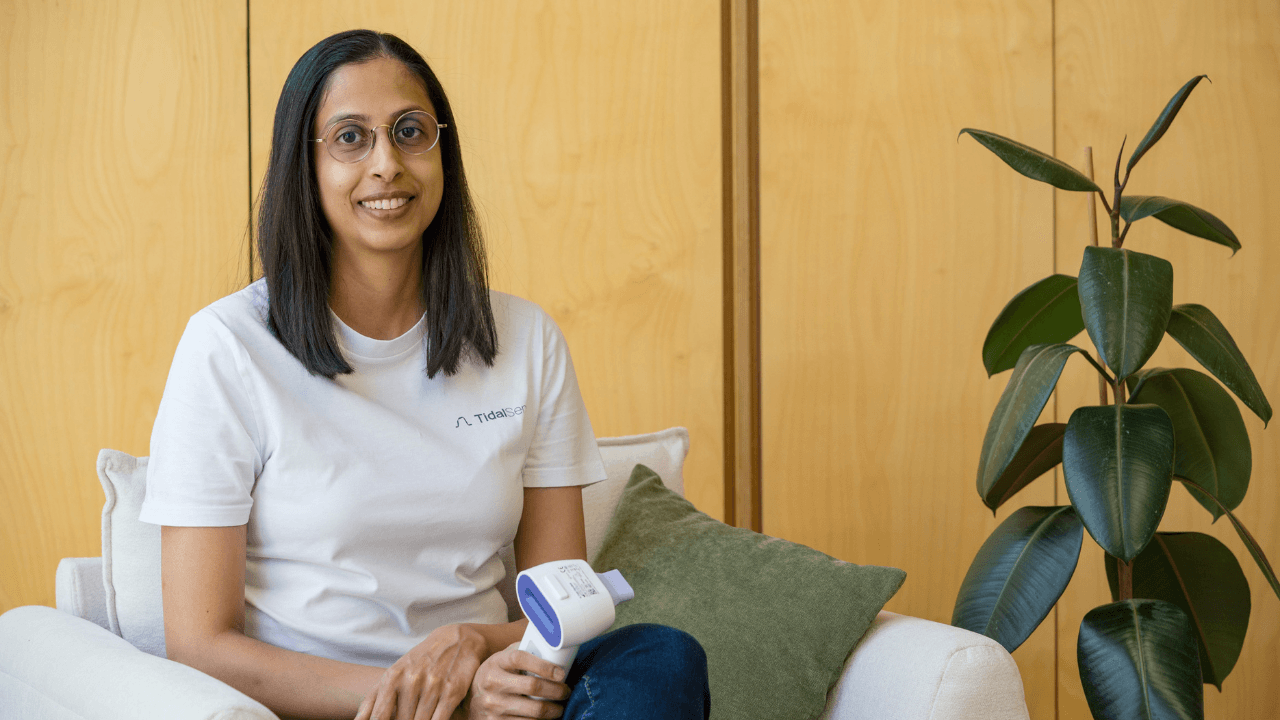
TidalSense is a UK medtech developing new ways to diagnose respiratory diseases, led by CEO Dr Ameera Patel, who is both a medical doctor and an engineer. Founded in 2013, the company spent much of its first six years focused on ensuring its hardware and sensor technology work reliably in clinical settings.
More recently, the company has focused on building a diagnostic platform on top of those foundations.
TidalSense develops novel diagnostics for respiratory diseases, including chronic conditions like asthma and COPD. It aims to develop technology that addresses the needs of patients, healthcare providers, and the broader health system.
According to Patel, you often hear governments talking about cancer and cardiovascular disease.
“That’s always really high on the agenda. Respiratory is never there.”
Why spirometry falls short
Lung diseases such as COPD are typically diagnosed using spirometry, a standard lung-function test that measures how much air a person can forcibly exhale and how quickly.
From my own experience as an asthmatic, it’s extremely hard to do.
Patel agreed:
“A lot of patients just can’t do it. You’ve got to be able to follow the instructions. You’ve also got to be able to do the manoeuvres. If you’re breathless, or you’re older and frail, or you can’t follow the instructions, you just can’t do it.”
For some patients, the physical requirements make the test impossible. Patel has seen patients with paralysis on one side of their face or body who are unable to form the necessary seal around the spirometer.
There are diagnostic limitations too.
In COPD, by the time spirometry shows something is wrong, the disease may already have progressed considerably. The test can also be nonspecific, with asthma and COPD sometimes producing the same spirometric picture.
Then there is the challenge for healthcare providers. Spirometry requires specialist-trained staff, takes at least 30 minutes to perform, and involves maintaining and calibrating equipment and purchasing consumables.
For some providers, Patel says, the economics simply don’t work. The test is also highly operator-dependent.
Different countries have their own accreditation processes, and insufficient training in administering or interpreting spirometry can lead to different interpretations of the same test.
A 75-second alternative to spirometry
TidalSense has built an alternative. N-Tidal Diagnose requires patients to breathe normally into a handheld device for 75 seconds, capturing a CO₂ waveform — a capnogram — of the kind traditionally used in critical care, which a set of AI models analyses to detect COPD.
The data is automatically transferred to its cloud platform, where signal-processing and machine-learning algorithms analyse the waveform and interpret patterns associated with respiratory disease.
Making respiratory diagnosis faster and easier
TidalSense offers several substantial benefits: Starting with the patient side, the test only requires normal breathing through the mouth, so just relaxed breathing.
“You don’t have to do any forced manoeuvres, which also means that it’s quite easy to train a patient to do it. You don’t need to sit there and explain how to do the forced exhalation. The other thing that’s really exciting — and we’ve designed the whole thing to do this — is for it to be really fast so that it can be used anywhere,” said Patel.
The median testing time is under five minutes: the hardware takes around a minute to warm up, followed by 75 seconds of normal breathing.
Data is automatically transferred to TidalSense’s cloud platform, with the diagnostic result available to the clinician during the same appointment and exportable directly into patient records.
Any healthcare professional can be trained to administer the test in 10 minutes, including healthcare assistants, pharmacy technicians, and paramedics. NHS clinics currently using the technology are running 10- to 15-minute appointments, enabling clinicians to see four to six patients an hour using traditional diagnostic spirometry.
According to Patel, patient feedback has been positive and providers also really love it because it’s easy to use, easy to maintain, and easy to look after.”
Solving for the health system, not just the patient
Interestingly, unlike many startups’ experiences with healthcare provider traction, it’s proved less challenging for TidalSense.
Patel asserts that new tech needs to “solve a problem for the clinician and the provider. That’s it.”
“We went into the product development phase of Tidal Diagnose taking those inputs in. I think a lot of times you end up with devices that haven’t factored the actual customer requirements and the actual health system requirements into product design.
There’s a significant cost associated with swapping out technology or installing new technology.
Speaking from my days as a former clinician, there’s a lot of cognitive overload. There’s a lot to get through in a day. Your new technology’s got to add value.”
Beyond COPD: tackling childhood asthma
While TidalSense is focused currently on COPD diagnosis, it has its sights set on asthma, especially in paediatrics. Patel shared that diagnosing asthma in children “is really the Wild West.”
“Trying to get kids to do spirometry is hard. Getting kids to do some of the other asthma testing modalities is also really difficult. So I think children are a really big underserved population, and there’s a really big unmet need for diagnostic testing in kids.”
Central to TidalSense’s approach is the use of machine learning to automate the interpretation of respiratory data. While spirometry produces a set of measurements that require specialist staff to interpret, TidalSense’s models analyse the captured waveform and return a diagnostic classification.
But Patel stresses that the company deliberately avoids unnecessary AI complexity.
“That’s our ethos: simplest possible. We don’t deploy black-box technology anywhere. If we have to, then we validate it to death and really control it.”
Its current diagnostic classification algorithms are therefore deliberately low-complexity models, with Patel arguing that medical applications require developers to understand both how models are learning and what can go wrong. Air quality is a big, big cause of both asthma and COPD. And then there’s shisha smoking.
Taking respiratory diagnostics into new markets
TidalSense is currently live in the East of England, with pilots in Wales and the South of England, and a new deployment in Scotland. It’s also looking for new markets because the problem of COPD underdiagnosis is everywhere.
“It’s much worse in some countries than others. In the UK, it’s two-thirds undiagnosed. That’s the estimate.
But in China, it’s something like 90 per cent. The estimate is just shy of 100 million patients with COPD.”