

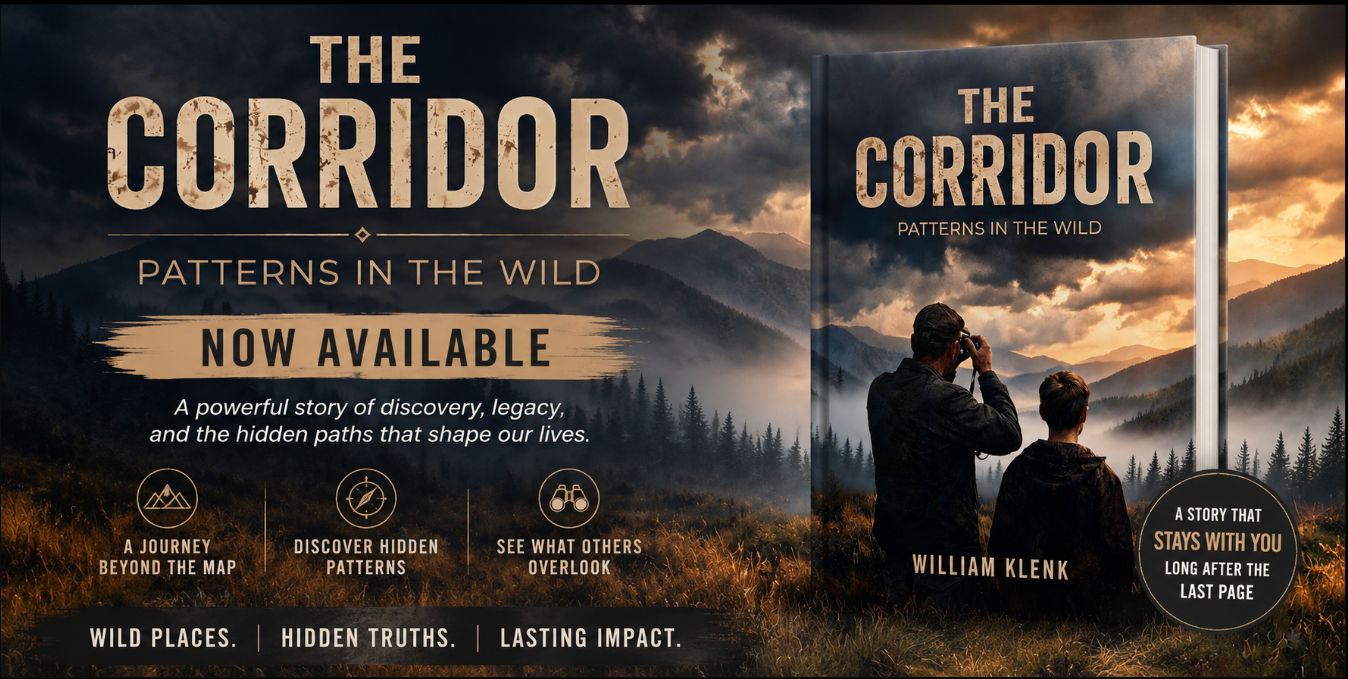
Atlanta, GA – Aug 29th 2026: What does it take to preserve something that has no voice in the decisions being made about it? William Klenk’s newly released literary work, The Corridor: Patterns in the Wild, considers that question through the relationship between a grandfather and grandson whose shared study of a wildlife corridor becomes an unexpected lesson in observation, evidence and family.
The story takes place in the Blue Ridge Mountains of North Georgia. It follows Richard, a longtime resident whose knowledge of the land has been shaped by decades of watching its wildlife, weather and seasonal rhythms. His grandson, Eli, arrives with a school environmental studies project and a very different way of understanding the natural world. When Eli chooses to document a wildlife corridor near Richard’s property, the two begin working together, combining Richard’s firsthand knowledge with Eli’s mapping, photography and technological tools.
The project gains significance when planned development threatens to disrupt the animals’ established routes. Eli’s research demonstrates the potential consequences for wildlife movement, while Richard is forced to reconsider assumptions he has carried for years about development, evidence and whether documenting a problem can actually make a difference.
At its center, the book is also a story about an intergenerational relationship finding new footing. Richard’s distance from his daughter and his initially uncertain connection with Eli give the environmental narrative a personal dimension. As grandfather and grandson work side by side, their contrasting approaches become complementary rather than competing. By the end, both have gained a greater appreciation for what the other knows.
For Klenk, the setting is closely connected to his own literary interests. Based in the Blue Ridge Mountains of North Georgia, he writes about Appalachian landscapes, rural life and the relationship between place and identity across generations. The Corridor reflects that focus by placing environmental awareness alongside a restrained family narrative.
The book arrives at a time when questions surrounding land use, environmental stewardship and generational knowledge remain relevant to communities balancing economic growth with the preservation of local ecosystems. Rather than reducing those questions to simple answers, William uses one family’s experience to examine the value of paying attention before something is gone.
The Corridor: Patterns in the Wild is now available to readers seeking literary fiction that considers family, place, environmental awareness and the knowledge passed between generations.