

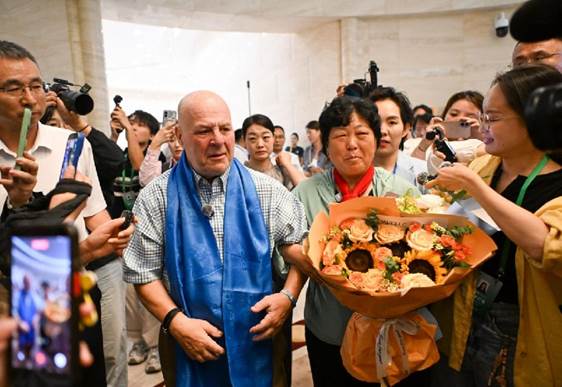
Ronald Sakolsky helped secure $5,000 for Yin Yuzhen to buy saplings in 1999. This summer, students at eHello Online English used their English to show him what that act of kindness had helped set in motion. In a photograph Ronald Sakolsky sent from his home in Plum, an 11-year-old Chinese student’s drawing appears in a black frame among pictures of his family. The drawing shows Sakolsky beside Yin Yuzhen, a woman who has spent four decades planting trees in the Mu Us Sandy Land of northern China. The student, Kate, first held it up during an online conversation in July. Sakolsky laughed, asked to see it again and printed it the next day. A story that began with an American teacher watching a Chinese woman on television had returned to Pennsylvania in the form of a child’s thank-you. That story began in 1999, when Sakolsky left his job teaching world history in the Plum Borough School District for a yearlong China-U.S. teacher exchange in Luoyang. After seeing a five-minute television report about Yin’s effort to combat desertification, he wrote to organizations in the United States until an institution in Boston agreed to provide $5,000. The money helped Yin buy high-quality saplings at a crucial point in her work. With decades of planting and care by Yin and her family, those saplings became part of a forest containing more than 50,000 trees. On Aug. 23, Sakolsky, now 69, returned to China and reunited with Yin for the first time since 2000. Sakolsky has never described the donation as a grand plan. He was homesick during his first months in China, and helping Yin gave him a sense of purpose. “It just got me in my heart,” he later said of the television report. Sending the money required weeks of letters, phone calls and cross-border paperwork, but he expected nothing in return. When he met Yin in Inner Mongolia in 2000, he saw mostly sand, few roads and none of the mature forest that exists today. He remembered running toward her and embracing her, startling her with the unexpected greeting, and eating the noodles she prepared for him. Then they lost contact, and for more than two decades he did not know what had become of the trees. Their connection was restored in May, after a video of Yin searching for Sakolsky spread online and reached his former students and colleagues in Pennsylvania. Soon afterward, Bella, Kate, Anna and Lucas — students at eHello Online English, an online English education provider — traveled to the Mu Us Sandy Land and met Yin.
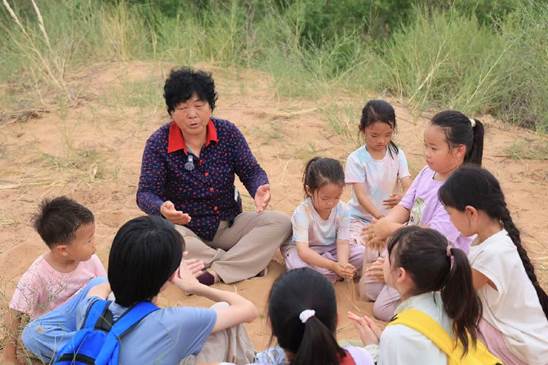
Bella, 10, had expected to see a desert as soon as she arrived in Inner Mongolia. Instead, she saw roads passing through broad stretches of green. “Wouldn’t ‘Mu Us Oasis’ be a better name?” she asked. The group had to continue driving before finding enough open sand for the children to plant new saplings. Five days later, the four students spoke online with Sakolsky while he sat at home in Plum. Lucas described green extending across the horizon. Anna told him about Yin singing and braiding her hair. Kate explained how difficult it was to keep a hole open in shifting sand. Bella said the trees continued for miles. Sakolsky studied the photographs they held up to the camera. “When I was there, there were no roads,” he said. “No trees. Nothing.” The students spoke to him in English, often without an interpreter. Sakolsky, who spent more than three decades in education, repeatedly praised their English as “outstanding.” Their accounts, he said, made him want to return sooner and see the forest with his own eyes. The four travelers were part of a much larger response.

Inspired by Sakolsky and Yin’s story, eHello Online English organized an English-language writing contest involving 25 students. Bella, Kate, Anna and Lucas wrote from what they had witnessed in Inner Mongolia. The other students learned about the story through lessons, documentaries and news reports. Some addressed Sakolsky directly and thanked him for helping Yin when her work needed support. Others wrote about environmental responsibility, perseverance and what ordinary people in China and the United States could accomplish together. The students who had not visited the desert were important for a different reason: they showed that something two adults began in 1999 could still reach children who had not yet been born when the first saplings were planted. Kate’s drawing made that new connection visible inside Sakolsky’s home. When her parents told him that its place among his family pictures made her feel included in his family, he replied that Kate “may certainly consider herself a part” of it. He then offered to become a pen pal to Kate or any of the other students, asking them to put “penpal” in the subject line so he would recognize their messages. Twenty-seven years after Sakolsky wrote letters seeking help for a woman in China, another exchange of letters was beginning — this time between a retired teacher in Plum and Chinese children writing in a language he had once traveled across the world to teach. When Sakolsky arrived at the airport in Ordos on Aug. 23, Yin saw him coming down an escalator and rushed toward him. They embraced and wept. Before leaving Pennsylvania, Sakolsky had recalled how their first hug had frightened her. “She will not be scared this time,” he predicted. She was not. Sakolsky continues to insist that Yin is the hero of the forest and that he was only “the little spark,” but the children had shown him how far that spark had traveled. “We need to focus on our similarities and not our differences to make the world a better place,” he told them. When Anna asked what he would call a new tree planted with Yin, he already had an answer: “Brotherhood.”